Monday, December 3, 2018

Rollercoaster of Soundness

Sure enough, when Penn finished his doxycycline for his fever, his soundness diminished. In addition to fighting tick borne disease, Doxy is also anti inflammatory. It helped make him look sounder than he was. We have had sound days, slightly off days, and then the Very Off Day.

A few Mondays ago (11/5 to be exact) was the Very Off Day. I'd been struggling with my posting dynamic, his right bend, half halts, my seat, and basically everything else up until this day, and Penn was having a bad rehab day and he struggled to walk evenly. Put all of that together, plus rider emotions and horse tension and I should have just gotten off 5 minutes in when I realized it was a lost cause. Nope. I lasted 20 minutes before flinging myself off my horse (which spooked him) and just hugged his shoulders and sobbed in the indoor. Penn stood very still and was like, "The human is broken. Whaaaaa...?"


He was so very lame. So incredibly lame. Uneven and tripping in the walk, uneven and hobbling in the trot. He felt like shit. I was thinking, "He's done. That's it. He's going to be retired and live in a field and never be ridden again."

Then came the next thoughts. "I'm making him lame."

He's sound on the lunge line, or at least the same level of sound as he was a month ago at his vet appointment. He is not sound when being ridden. You do the math.

So then I'm reflecting on how I'm riding him: I've tried up and slow, lame. Letting him out ended up in a turbo trot that was even... or so turbo I couldn't tell if he was lame or not... but he had the unbalanced legs of doom running on the forehand and leaning heavily on the right shoulder. I couldn't seem to make a half halt work and get him off his right shoulder, so he eventually felt lame again.

Complete and utter disaster.

I arranged for a friend to be out 2 days later to get video for GP Trainer and the vet. The vet would be able to see the lameness and compare it to what she's seen before, and GP Trainer could have a look at what I'm doing to him to make him lame.

The following will make my arena sobbing look extremely dramatic.


Watch the right trot video again: the "unbalanced" steps? Those are lame steps. Vet confirmed yo. I thought they were when I was riding, it was nice to know I wasn't being crazy.

I have to thank Jenj and Megan for talking me down, both had super tips to go with my comments of "I can't ride" and "I'm breaking him" and "how did I get my bronze, I'm terrible" and the actually much more helpful "I've lost control of his body parts and he lays on the right shoulder and flings his ass left, what do I do".

Megan encouraged me to keep his haunches in when tracking right, and said 'yes, you can use your inside rein to help keep his shoulders and nose pointed correctly, as long as you give it back and don't hang on it.' Jenj reminded me that first level includes leg yields for good reason- move the shoulders around frequently and he can't lean on one of them.

Even so, the horse in these videos is much sounder than the Very Off Day. We went on to have a day that felt absolutely fantastic- he felt sound and normal and pliable and wonderful, in addition to being light in the bridle and connected. We went on to have some days where I'd feel him start to take lame steps, but I remembered how to adjust his balance with my seat and he got better.

Every time someone was around to video the unsoundness I felt, he would feel fine! It was awful not being able to get video of his unsound days. I swear, the people at the barn must have gotten used to "that crazy girl who thinks her horse is broken."

There isn't a whole lot of content to this post, but I needed it as a precursor for the next FIVE posts that detail our disastrous trips to VA over my Thanksgiving vacation. Stay tuned folks.

Saturday, November 17, 2018

A Little Less Drama Please

Can we please, please, just have a little less drama? Penn's recheck took an interesting turn that resulted in him staying in VA at GP Trainer's barn instead of coming home with me (hauling 6 hours between PA and VA Friday, Saturday, Monday, Tuesday was stupid).

Thank goodness.

Being rescued from the PA turnpike since we lost our brakes.

More later, there's already plenty to say, and I'm sure after next week's tests there will be even more.

Wednesday, October 24, 2018

Sound!

Hey lookie! Penn is sound! And feels better!

I got him new SMBs- professionals choice ventech elites in charcoal!

Just ignore basically everything else about the video, except his soundness. We're rusty and out of shape, and he wants to go way more forward than he's allowed to right now.


Monday, October 15, 2018

Fever

As GP Trainer commented on my Instagram post about this... "For the love of Pete, get it together horse!"

Last week PA finally decided it was time for fall/winter. And it decided that "OMG I'M LATE BETTER DO IT RIGHT NOW." And our temps went from 80s to 40s/50s overnight. Not kidding. Wednesday last week, the high was 81 at 2:10pm. It was still warm and super muggy when I rode Penn that evening. The high on Thursday was 71, and it happened at 2:53am. The morning was muggy and awful, and by afternoon it was windy, frigid and downright cold at around 55 degrees. Just under 30 degrees in 24 hours. That same night, severe thunderstorms came through the area, forcing Penn to stay in since he doesn't have shelter and sometimes the storms upset him. When I put him away Wednesday, he was ANGRY.

When I went to get him from the dry lot Thursday evening? He was sick.

"I don't feel good."

He was just standing out there, hanging his head, butt to the wind. He called to me when I approached the paddock, but then went right back to hanging his head. He called again when I got to the gate, then resumed hanging. I called for him, but he didn't even glance my way. I walked over to get him and he nickered a little but went back to hanging. I pulled off his fly mask and his eyes were just glazed and dead. I ran my hands over all of him while he was still in the field- nothing. No bug bites, no swelling, no hot spots.

I called the barn owner, hoping that he was being naughty at some point during the day and they aced him to keep him quiet... I didn't get a hold of someone right away, so I went to bring him in to take his temp. And he wouldn't move. I had to drag the poor horse back to the barn. He was puffing, looked exhausted, and was having muscle tremors standing in the barn. I left him in the aisle (hell it would be a good sign if he got up the energy to run away!), pulled out a thermometer and got to business- he had a fever of 102.2 and looked like absolute misery. I had a minor crying meltdown- this poor horse is having a terrible year and now he has a fever. And of course, in my head, he's dying.

Such a sad creature.
Note the untouched hay in the background.

After getting back some emotional control, I called the emergency vet line next. They connected me with the on call vet, who was out 30 min later. While we waited, I took him back to his stall and basically plopped him right on top of his water bucket. He was like "Oh water... that's icky. Oh wait, maybe I'm thirsty." He tried to lap it up like a dog, made icky faces, then settled in to take a good drink. He did that a couple times and by the time the vet showed up, he had drank about an inch and a half of a normal water bucket.

Looking sedated. Only he's not.
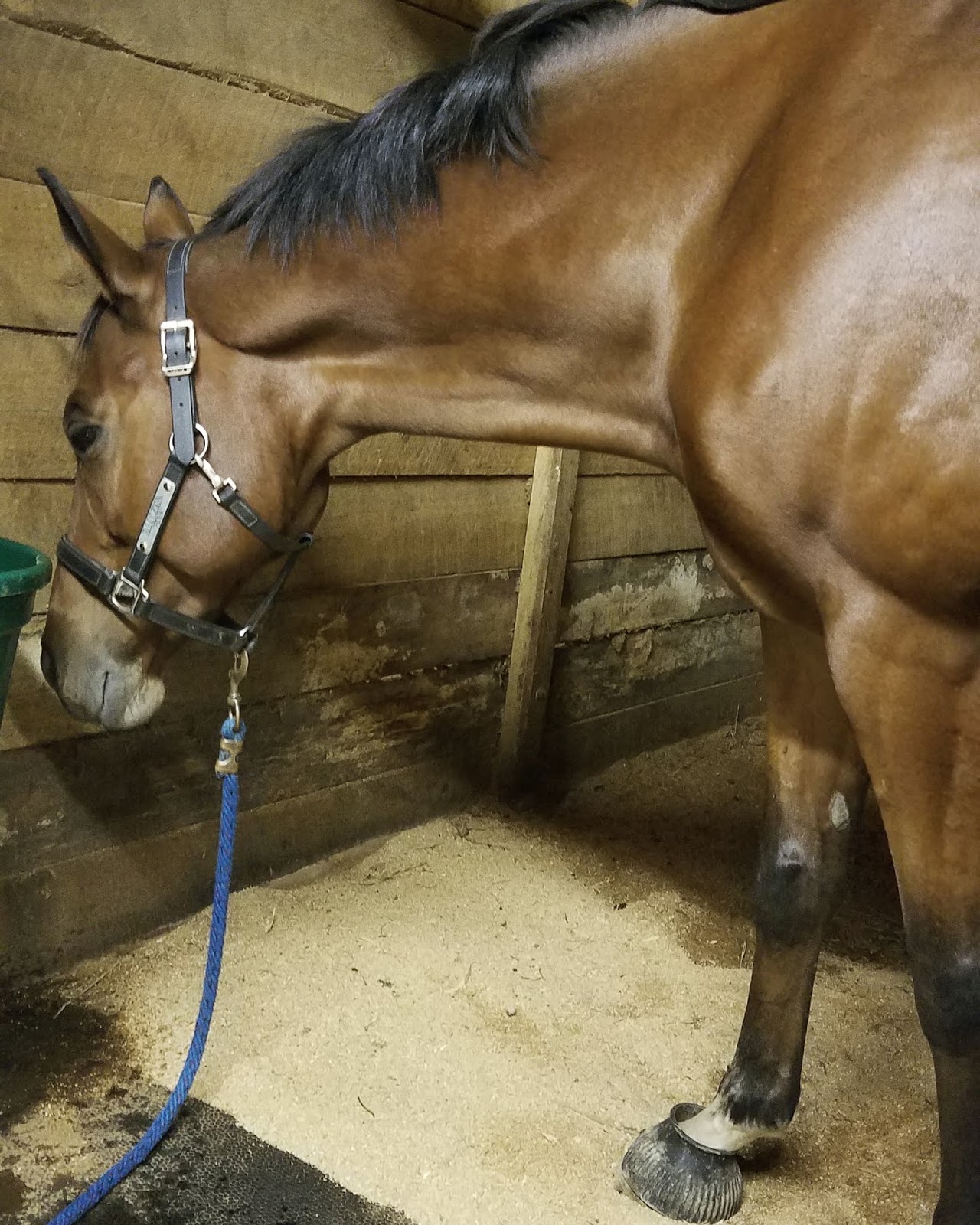
Poor guy. 😔

I took his temp again while the vet went over every inch of him- 102.8 a half hour ish after I took it the first time. His other vitals were good, but he had decreased gut sounds. We weren't too worried about colic, not with the fever, and the decreased gut sounds were logical since he hadn't eaten much since the night before. He didn't want his breakfast (normal) and was still angry in the morning from being in alone (normal). What wasn't normal was him not touching his hay in the dry lot. It was still as pristine as it was when they dropped it for him that morning.

Barn owner reviewed his turnout and stall hay for freshness, mold, and any possible weeds and found nothing amiss. We checked out his Alfalox (which I had given him A LOT of the night before), and it also smelled and looked just fine. I was concerned it had molded, since I open a bale of it and it takes a month or so to go through it all.

He had no swelling, no cellulitis, no bug bites, no digital pulse, no abscesses brewing... nothing. The vet settled on anaplasmosis because there just wasn't any outward evidence of injury. It's a tick borne disease that causes high fevers quickly. Penn had a similar diagnosis last winter, except his legs swelled badly. When I went through the basic list of illnesses, my brain crossed it off because he only had a fever and the symptoms of a fever. There didn't appear to be any fresh tick bites, but OK since tick diseases do funny things.

He got IV banamine first, and after about 10 minutes he perked up considerably. Enough that he went to his hay net and was like, "Ooo, nommies!"

Sorry, didn't realize this was blurry when I took it!

Next she drew a lot of blood- enough for a CBC, blood chemistry, anaplasmosis test, and some extra if things were wonky. She would run the CBC that night, if it came back with anything unexpected, she'd run the blood chemistry, and we'd hold the anaplasmosis test for if he wasn't getting better. It has to be shipped to Cornell, but we wouldn't have results for it on Friday or over the weekend, so we opted to hold it since I would spend about $150 on that. If he wasn't making enough progress, we'd send it and do other tests.

Finally, he got IV oxytetracycline. This needs to be followed up with 2 weeks of doxy, which he's currently still getting.

The last instruction was to take his temp AM and PM to make sure it didn't spike again.

I sat with him for a while Thursday evening to make sure he stayed interested in his hay. Barn Owner put her mobile security camera in his stall so she could watch him from her house during the night. When I left him about 3 hours after originally finding him, his temp was down to 101.8.

I got a text from the barn owner the next morning; he ate a lot of his hay, all of his dinner from the night before, and was interested in people again! He also pooped like normal, wahoo! Horse people are so funny about poop. He was a bit upset at having to stay in, but I was glad to hear about that very normal response. His temp was 101.4. Apparently that's in the "normal" range for horses... except he's usually 99.2-99.5, so that was still 2 degrees higher than normal for him.

The weekend carried on in an excercise of "OMG is he ok" "what is his temp" and "is he still eating".

This stall is not nearly walked enough.
He didn't feel better yet. 

So what exactly caused this episode of "Scare the Shit Out of Your Mother?" Weather maybe? Angry horse? Ticks? All of the above? I have no idea.

So as of this writing, Penn is back to normal. When I checked on him Sunday morning, he was back to his usual shenanigans. I stopped on my way to his paddock to talk to someone, but apparently I took too long. He had come up to the gate and was displeased, so he started pacing... then attacked a barn cat that was walking on the fence. He pranced up to it, then spun and double barrel kicked at it. Don't worry! The cat was never in any real danger.

I took him for a short ride since he was well enough for those shenanigans and he felt fantastic. Oh the perks of doxycycline! It seems to have taken care of his lingering hoof inflammation.

I'm keeping my fingers crossed that he stays on the up. Come on Penn, haven't you ever heard that it's ok to be boring sometimes?

Thursday, October 11, 2018

Better News?

I was extremely anxious coming up to Penn's next vet check... hence you got the sad and sappy "Still Here" post. I'm trying not to get my hopes up about him healing properly and completely, so I have a ton of back up plans in my head for him. "If he's completely fine or can at least do ABC, he'll stay with me for a while yet. If he can't, but can do DEF, there's plan B. If he's not even able to do XYZ, there's plan C..." Yadda yadda yadda.

This snoot is mine though! Never for sale or given away.

Penn was reset Wednesday last week (2 days before we went to the vet), and I noticed his LF fetlock had a big bump right smack on the outside as I was waiting for the farrier to get his special shoes forged and hammered. WTF horse? Of course I didn't get a picture of it.

Farrier also tried out a new shoe that's a bit bigger and will allow the heels to be set back even further, which the vet wanted when I emailed her pics of his last reset. The shoe also doesn't have a flat surface- the entire bottom that touches the ground is beveled. That is, except where the medial flange of the RF is still pounded wide for support. The new shoes also allowed that to be a bit wider.

Mega pad and shoe.

Friday morning, I pulled Penn out of his stall. The left front had blown up.

Ok, so maybe that's not "blown up", but on a leg that has been tight throughout all of this, it counts as blown up.

I sighed and thought, "At least he's going to the vet today." Wrapped him up in no bows and off we went!

We had a very uneventful drive this time: no K turns with the trailer in driveways due to closed roads, no new chips in the windshield.

Since I was a bit early, I decided to try pulling off his bell boots so the associate vets wouldn't have to... I managed to mangle my thumb in between the boot and his shoe and gave myself a nice blood blister. I decided to just let them pull them off... they're much more experienced with that kind of thing. Turns out they couldn't get them off either. I held his leg, they pulled and the shoes are simply too big for the bell boot to come off over them. Facepalm. I love these bell boots, they're tough and they're big enough to cover that massive set back shoe. I'll have to be smart about pulling them off when he has his shoes reset in show season, but for now, they can stay on.

The first thing Dr Cricket did was check out the LF. The swelling had subsided to practically nothing after being wrapped for 6 hours, and he didn't react to any palpation, so she didn't think there was much to worry about there. She figured he probably banged it on something and to keep an eye on it.

Penn was jogged on the straight line, on a circle on a hard surface, flexed and jogged on the straight line, then went back to jog on a circle on an arena surface.

Verdict?

"Hi, if you're going to just stand there and text on your phone, I need snuggles."

He's still lame.

BUT.

He's sound on the arena surface.

The findings were as follows:
  • <1/5 on the LF on hard surfaces tracking left
  • 1/5 on the RF on hard surfaces tracking right
  • Sound both directions on arena surfaces
  • LF lower flexion unremarkable
  • RF lower flexion mild/moderate
  • LH upper flexion mild
  • RH upper flexion mild/moderate
So what does that mean?
  • He is doing much better than before- while it is mildly concerning the LF is showing lameness now, the RF has improved considerably so we're on the right track. He has bi-lateral lameness in the fronts (this article is excellent at defining it and symptoms). The RF used to be visible both directions, now it is only visible to the right.
  • He is serviceably sound.
  • He will probably need hock injections soon.
  • He needs more time and very slow reintroduction to work.
The only diagnostic left that Dr Cricket can do is an MRI. She didn't feel it was necessary at this point. She thought more time would give us a better indicator of what's to come for Penn. I'm going to talk to his insurance company to see how much of that they'll cover, so that it is an option when we go back in a few weeks.

So what's causing all this general lameness? Well the answer isn't great. She thinks the tendon has healed sufficiently on the right front, so it's no longer an issue. However, his general foot and leg conformation is working against him. He also wants to stand close up front and walk like a cat with one foot directly in front of the other. Basically, it's how he's put together. That's a super shitty answer, but one I can get behind. Normally a horse like this would have been weeded out in the PPE process and not gone on to the career he's had.

The left front leg is completely rotated out, while the right front turns a bit more from the knee down.
As crooked as his fronts look in this pic... they are straighter than they were. Trust me.
So what's next? Well, it's not all gloom and doom. He's allowed to start trotting again! We're going to start an ultra conservative trotting program:
  • Total walk time can increase from 20 min to 25 min. Walk for at least 10 minutes before trotting. All trot needs to be split equally between both directions, and have walk breaks in between trot sets.
  • Week 1: 2 minutes of trot.
  • Week 2: 5 minutes of trot.
  • Week 3: 7 minutes of trot, done in sets of no more than 2-2.5 minutes each.
  • Week 4: 10 minutes of trot, done in sets of 2-5 minutes each.
His next appointment will depend on when his insurance runs out- I have 90 days after his policy period end to make further claims. I need to find out the exact details on that, and how much more coverage I can expect, then I'll make a recheck appointment for a week before that date so that I can be sure an MRI won't break the bank if his soundness has gotten worse. He's still going to go back, but I'd like to have at least one more visit be in that 90 day coverage period.

I did ask about equioxx for him- Dr Cricket didn't think we were there yet. She thought there's still some improvement he can make without it. She generally prescribes it for horses that they can't seem to get that last bit of lameness handled. So that's in my head and on the back burner for later maybe.


Despite such a small amount of trot, it's very exciting! I trotted him Sunday, and he felt heavy on the right shoulder both directions (worse to the right) and I had trouble getting his balance shifted in the one minute trot sets. I had to settle for keeping him longitudinally balanced to keep him off his forehand.


I also wanted to note: I did try these CBD pellets for Penn's general well being. They were the only pelleted version I could find, period. I found a single powder too, but it was slightly more expensive and Penn hates powder. I wanted to make sure I could measure it out for the barn staff, and liquid just wouldn't cut it since it would have to be eyeballed or drops counted. The pellets have no detectable THC (obviously I have to take their word for it), which was important because Penn didn't need to be "high" and it had to be safe for me and the barn staff to handle in passing.

I found researching it extremely difficult because there's a lot of anecdotal evidence and not a whole lot of science (free the hemp plant! for science! because you know if it wasn't hemp, it would already have science). Most places said start with a low dose, give it time, and see if you achieved the results you wanted, then increase as needed.

Penn got one scoop in the morning and one scoop in the evening for 1 month (75mg per day) to start.

DOSING GUIDELINES:
General Health: 75mg CBD twice daily has been effective for most average sized horses. Two scoops of pellets contains 75mg CBD. 
Chronic Pain: 100 to 200 mg/day
Anxiety: 50 to 80 mg/day

Pre-CBD Penn: I put up with a lot of his touchiness because he's mine and I love him lots. But by week 10 of our 17 weeks of walking, I wanted to kill him. He would stand in the cross ties and scream for me if I walked around the corner. He was excessively attached, looking for comfort ALL THE TIME when I was near him. He was standing very tall all the time too. He started nipping at horses as they walked past his stall, enough that he needed to have his stall bars closed entirely, no more hanging his head out. He had an excess of energy that was amplifying his needy personality and barn insecurities. I didn't have many riding issues with him, that's when he was on his best behavior. He got a little spooky as time went on, but nothing too far from normal. He was running every chance he got in his tiny turnout.

Post-CBD Penn: He had a day of diarrhea (still solid and turd shaped, but a hair looser than normal). Within a couple days he was back to his old mellow self. He could tolerate being in the cross ties. I could walk away and not worry about him freaking out. He was back to relaxing and taking naps. His eye was just softer. He slowly started to stall walk less, and then eat more since he wasn't spending half his day walking. He didn't scream the minute he heard my footsteps in the barn. He was the same steady guy to ride. He still moved around a bit more than he should have, but it wasn't as bad as before.

After that first month, I upped him to 75mg (two scoops) in the morning and 37.5mg (one scoop) in the evening, hoping to hit that chronic pain threshold. I don't have a verdict on that because a couple days into it, I pulled him off it entirely so it would absolutely be out of his system for his vet check (I allowed 5 days). He went back to stall walking almost immediately during those 5 days.

At a minimum, Penn will stay on it until he goes back to a normal routine. Maybe he'll stay on a low dose to keep his stall walking to a minimum. We'll just have to see!

Sunday, September 30, 2018

Still Here

We're still here folks.
Penn is still lame as far as I can tell.
Recheck Friday will mark 17 weeks of rehabbing.
Wish this snoot would get better already. 😥❤🐎

Thursday, August 23, 2018

Well F**k

Alternate Names for This Post:

Feels like Groundhog Day: 7 more weeks of walking!
Reasons to buy a horse with straight legs.
GO TO A CAPABLE VET FOR YOUR PREPURCHASE FOLKS.

He likes it at VEI, he just watches out the window and in general is very relaxed!

I'm going to bet you've gathered Penn's recheck didn't go so well. It's really not all gloom and doom, but this is something I could have avoided by not buying Penn. True story folks.

Oh yea, this also happened on our drive down. A dime sized chip in my truck's windshield.

Let's rewind a bit, last we left off, I had gotten bored out of my mind and trotted Penn briefly because he felt mostly sound at the walk and I wanted to see how the trot went. I knew walking into this appointment that he was still lame. Doing better, but lame. I expected 4-6 weeks of additional walking.

First thing they did was take his temp (they're now monitoring all horses, taking their temp before they set foot in the barn), and do a general body evaluation. She noted that he kept his muscular conditioning beautifully, and I mentioned that I'd been making the most of our tack walking by really encouraging self carriage and lightness of the forehand ("It can only help take weight off the front end right?"). I was worried that actually working him at the walk would be bad, but she approved wholeheartedly about it and didn't tell me to stop what I was doing. She liked how his shoes were- they have great breakover and the toe is short enough. She'd like the shoes set back even more for more heel support though. The RF medial branch is wonderfully wide to support the inside tendon as it heals.

The first test she did was watch him walk and trot on the straight line, where the RF lameness was still there, but only a 1/5! We went down to their covered hard surface round pen, and he trotted again. He was <1/5 unsound on the RF when tracking left, and 1.5-2/5 RF when tracking right.

Back up to the barn we went and did some flexions: The hind flexions didn't bring up anything worth noting, but they did flex positive. Dr Cricket wasn't concerned about them because he didn't trot lame in the other tests; in fact, his hind end was more sound than it was 10 weeks ago (and we had resolved his previous hind end lameness by blocking the front legs). The front flexions were interesting though. Flexing the lower RF made him more lame on the RF (as expected), and flexing the lower LF made him more lame on the RF (what?). She didn't explain why that would be, but happily noted his LF lameness from the previous visit had gotten better.

Look! It's my pretty garden! I'll use it to break up some text.

The next thing she wanted to do was nerve block directly below the strained tendon on the RF. He hadn't gotten that much sounder on the RF in 10 weeks, so she wanted to know if it was hoof or tendon injury that was bothering him.

Nerve block done, off we went for the straight line and circle trots.

Fuckity fuck fuck.

He was 90% sound.

So the problem isn't mostly the tendon, there's a problem in the hoof. Off for x-rays. I asked her to do some shots of the LF too, because we had discussed him possibly having sidebone and I wanted to know. We opted to leave his shoes on since his foot shape is quite wide, and it's a 5 hour drive home. They thought they'd be able to get the angled shots through the shoe (I'm not sharing those because I don't really know what they show), and if they couldn't get what they needed to see, they were going to pull his shoes and I would call GP Trainer and ask for her farrier's number to put them back on.

Well his feet are a bit of a mess internally, and I doubt any of it is new. From what I can glean from his PPE x-rays, now that I know exactly what I'm looking for, I can see traces of all of it. His PPE x-rays are so blurry and low res that it's really difficult to see... so I can see why some of it was missed, but I'm kicking myself now. I would have sent Penn back to his breeder if I got the below news 3 years ago. Sorry buddy. I love him, and I don't really regret buying him, but I would have done the extremely hard thing of sending him back.

Red cicles: remodeling of the coffin bone, worse on the LF, which also has remodeling on the P2.
Red lines: Neutral palmer angle (I may have drawn the line wrong, sorry), aka flat footed.
Yellow arrows: The horns of the coffin bone. They should sit next to each other on this view, not be offset.
SO CROOKED.
Lower red circles: mismatch/crookedness of the joint- the outside of both legs have less space than the inside.
Upper red circle on LF: Sidebone
Vertical lines: The coffin is shorter than it should be from this view (flat footed).
Horizontal lines: The coffin is also crooked. The RF is worse. There is more sole on the outside edge of each hoof in addition to the leg itself being crooked.

Of course by this point, it's all red alarms going off in my head ("My horse is so crooked he's never going to stay sound while in work."). I knew his legs were turned when I bought him, but the twists keep going all the way to the ground internally. The idea I got from his PPE was he would just have some flail in his front legs when moving. Not that I need to be actively getting x-rays taken to ensure we're shoeing him correctly for his internal confirmation. The vets had a very difficult time getting x-rays straight on enough to make an evaluation. Dr Cricket did say something about his navicular bones, but honestly I can't remember what because it was low on her list of issues to deal with, and sounded like it should get better as we correct all the other things.

Any sadness I feel is really being offset by the anger I feel towards his PPE. I can see the sidebone in the PPE x-rays, albeit faintly, but it's there (but it is NBD for now). This level of crooked isn't new. That tilted coffin? Yea, I can see it because in the one side shot, they angled the machine in such a way that the coffin looked straight... and the shoe he was wearing curves right off the bottom edge of the x-ray image and all you can see are the far side nails reaching up to the bottom of the shoe on the near side. I could have sent him back, or I could have prevented a lot of his issues by simply having him shod to the x-rays. He's heavy on the inside of each hoof, meaning without correction, he'll probably keep tearing the medial branch of the suspensory tendon. Don't forget the fetlock joint remodeling that Dr Cricket found in our June visit. That was one the PPE did find and called it nothing. I didn't know any better and I was still deep in Mikey's loss and didn't question it.

Speaking of buying him, we celebrated his 3rd Gotcha Day same day as his recheck. Oh the irony of his PPE being almost 3 years to the day as this recheck.
I got him a belated present, a name plate for his every day halter, just what every horse wants! Lol!

On the bright side, we can shoe to correct a lot of these issues, now that we know they're there. It'll take time, but it's doable. What we can't fix is the coffin remodeling (or fetlock, but that doesn't appear to be an issue as it is significantly less). That will only get worse as he ages and as he works. We decided to inject both of his coffins, even though the RF is the one that's hurting. The LF is actually worse off, so it's actually a good thing that he has more pain in the RF.

Bandaged after coffin injections, and receiving his shockwave treatment.

Another bright side, the ultrasound showed that the attachment of the medial branch of the suspensory is looking great. It is almost identical to the good lateral attachment, but the tendon itself isn't as 'dense' as the good tendon. All that means is he needs more healing time, and more shockwave if we can manage it (we will manage it). He got a shockwave treatment at VEI, and he'll get another 3 weeks later, then he has a recheck at VEI 4 weeks after that.

I finally remembered to ask about a prognosis. She kind of didn't answer the question, but she said we can keep injecting the coffin to keep him comfortable (we'll come back to this), and this is first and foremost a soft tissue injury, which takes a solid 6 months to fully heal. Cue the ridiculously long tack walking... we'll be 17 weeks of tack walking when he goes back for his next recheck. I know she is looking at this in the long view- sound to perform his job like he did before. She's hopeful he'll be healed enough to start trotting after his next recheck. That's about all she was willing to commit to.

I get the feeling that he shouldn't have a problem returning to full work in time- maybe by the first quarter of 2019. I can appreciate that she's looking at this for long term soundness with a low reinjury risk and is taking an ultra conservative approach. Either way, Penn won't be leaving me, ever. I won't sell him or give him away, not knowing what I do now (not that I was planning on it, but things happen). If he can return to 3rd level, but not progress further, I'll work on completing my bronze bar. If he can't do 3rd... we'll see what he can do and I'll work on what part of my bronze bar I can. Then depending on his level of comfort, find a nice AA lady who wants to lease a lower level horse with a ton of experience.

I have a long term tranq on order. He's been generally good, but he's starting to get a little feisty when he's not being ridden. Can't wait for it to get here! I'll stop worrying about him doing stupid things. In the last 2 weeks he's ripped a flysheet, cut his hind leg, and rubbed holes in both hocks. No one ever sees him do more than mosey around and eat hay. If they saw more, they'd catch him and bring him in!

For now, he's having every whim catered to. Including breakfast outside because he simply could not tolerate being in his stall a moment longer, even though he had to be carefully bubble wrapped after his coffin injections.

This is where I'm reaching out the blogosphere think tank:

I am NOT keen to inject his coffins every 6 months to a year for the foreseeable future. He's only 9, if we're only looking at yearly injections, we could do that 10 times before he's 20. I don't think that's a viable plan. He'd need a step down in workload at that point, not injections. Note we're not looking to willy nilly inject him yearly on a set schedule- it'll be when he cues that he's hurting again. 6 months is as frequent as is "safe" but more than a year seems overly hopeful. I've been a bit lax on his Adequan this year (he hasn't had a dose in about a year), but he's going to go back on the single dose every 4 days for 7 doses, every six months. Home vet and I talked about doing Prostride coffin injections instead of a steroid. VEI said we can do steroids until that doesn't manage it, then step up to something I don't remember, then step up again to PRP/APS injections. I've had him on Doc's OCD since he came home from VEI the first time, since it should address bone problems. We will be doing yearly hoof x-rays to keep track of the remodeling.

I'm looking for things (preferably USEF show legal, but usable with withdrawal periods is fine too) that we can do to make his coffin injections last longer. Holistic is fine, a different option than Adequan is worth looking into (I'm not sure how effective it was for him), and cost can be moderate. Barefoot is not an option. He has a vet prescribed plan in place that I intend to keep to. Other than that, I am open to suggestions.

One suggestion I've already looked into is CBD oil (it'll be fed powdered or pelleted), which has gotten a warm response from two of the vets I've talked to that are involved in his care. I'm just having trouble getting a hold of solid information about its use in equine care. I find a lot of "Are you ready to be pain free?" in bold letters on information pages that say a lot without actually saying anything. It needs to be pure and THC free (meaning non-hallucinogenic), and that's about all I've got.

Let the opinions roll!